Saturday, March 28, 2009

Haiku Death Battle

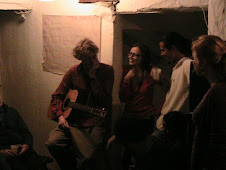
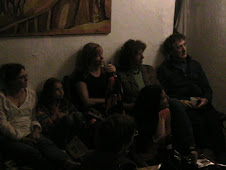
Why is traveling so interesting? Other than the change of scenery, exposure to other cultures, new food, and challenges in life, I can't think of anything interesting about it. Oh, except the really interesting, creative people you meet.  It has become abundantly clear that the group of people we associate with are multitalented; athletes, musicians, artists, professional hula hooper. But the talent has been showcased mainly at a monthly poetry night which several of the teachers organized.  It turns out that our family has some talent too.  Lizzie inspired an event ultimately entitled "The Haiku Death Battle".  During a previous poetry night she was reading original haikus she had written in between the other teachers readings and performances.  
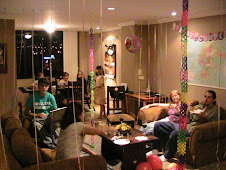
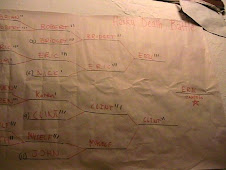
The high poetry council then decided to create a Haiku competition.  This was a well defined event with strict rules that some of the creative participants had difficulty adhering to.  In additions to the strict meter of this form of poetry (5 syllables, 7 syllables, 5 syllables) there was also competitor denomination through colors; red competitor and non-red competitor (in this case blue), no audible clapping or laughing so as not to influence the judges (clapping was a one handed pushing of air and laughing was a jiggling of the hand back and forth.), and red and blue sticks used by the judges to indicate poem winners.  Each round was followed by a brief normal clapping which had a length strictly orchestrated by our event conductor.  I had a hard time stopping my clapping in time and was remonstrated by our M.C. 
Bridget and Lizzie both participated in the event and Julian had his own age appropriate event to attend, a quinceanera, which is almost like a sweet 16 but happens when girls turn 15 and are almost like proms in their formality, grandiosity and size.  There was some discussion about whether Lizzie should be able to participate, because there was fear that she would win on cuteness instead of the quality of her poems.  But I imposed on the high poetry council's kindness to allow her to participate because she did inspire the event and she worked hard on her creations.  Both Bridget and Lizzie made it to the semi-final round and there were some who would have liked to see a final round between us, but I was not looking forward to that type of mother/daughter competition.  Fortunately we both lost in that round and did not have to face each other.  Norm contributed to the evening by video taping much of the event and reciting some excellent Bertolt Brecht poetry, not of the Haiku variety.
Below you can see our creations for the evening.  There were so many great poems.  We hope to be getting copies of them all to add here.
Eliza's
1. A proud white harp seal, 11. Girls want to have fun,
Gets chased by a white shark as, We laugh and play all day long,
A whale saves the day. Our fun never ends.
2.A flaming candle, 12. Glassy and clear cup,
Glows in the night while we sleep, Sparkles with water in it,
The soothing crackle. As I drink it all.
3. Pencils on my desk, 13. EXIT
Many pencils on my desk, Four lit green letters,
Clatter on the floor. Awaiting our departure,
4. The flowing rivers, Proud of their success.
Run rapidly to the sea, 14. Screaming eyes of light,
Where the sharks are born. On stone hearts and souls reflect,
5. Lonely pebbles form, Peacock feathered bright.
Massive piles of grey matter, 15. Piano
In streets of Cuenca.  Carved wood painted black,
6. Merry Santa Claus, Openly awaiting touch,
Bring presents to kids at night, To steal the silence.
Watch out he might not. 16. A tiny spider,
7. Pretty butterflies, Crawls up the bedroom wall,
Fly by my window at night, As I am sleeping.
Fly into the dark. 17. Green guacamole,
8. Poor old cute Jasmine, Made out of avocados,
died getting hit by a car, Chips are good with it.
Oh we loved her so. 18. I have a rainbow,
9. Pretty flowers wait, Glowing in my beating my heart,
To bloom on the start of Spring, Where Jasmine is still.
Growing each Spring Day. 19. I feel a cold chill,
10. School School so boring, And I know winter is here,
I go there every five days, So I call my friends.
I learn math and art. 20. I look out my window,
And see something wonderful,
A horse white as snow.

Bridget's
1. White Stripes 8. Rejuvenation
Chosen from the herd Blood slips through my veins
For her sexy hind quarters, My body an hourglass.
Loved for her thick stripes. Time to turn over.
2. Possessive Adjectives 9. Perverse Technology
My spouse, my child, mine! ipod, itouch, wii.
Can I really be loving, These predators devices,
Without owning you? preying on children.
3. Roseanne Barr 10. Exercourse
Little facial lines 1, 2, 3, push, aahhhh!
Make sane women consider  Why isn't getting you out,
cutting their faces. Fun'az getting you in?
4. Face Dander 11. Parenting
Mucous tinged mustache, To this helpless babe,
Man allergic to own beard. We just became the utmost
Choo, he blows it off. important people.
5. Ode to the Queen of Haiku 12. Falling Down
Animal lover, Scrape off a layer.
Gorgeous adaptable girl, What lies underneath the skin?
We think we love her. Another layer.
6. Miedo in la Amazonia 13. Traditional Haiku - Cuenca
Twisted trees in muck, Morning, October,
An anaconda lair slog, By noon, it's April,
She dies, heart attack. December doesn't come.
7. Love 14. Avoiding Nasty Movies on Long Bus Rides
Let me slip into  Shove her head in seat, 
Something more comfortable. Stab my fingers in her ears.
How about your skin? Lizzie, stop watching!
15. Julian's Consciousness 16. Rivalry
Life flashed before eyes                                      If I give you both
Stay away from the white lights, The same gift, it doesn't mean
Puberty begins. That you are not special.


Tuesday, March 24, 2009

Banos Ambato

This country never ceases to amaze us in terms of the diversity of scenery, resources, fun diversions, and just plain weird stuff.  One of the unique aspects of the culture here is the emphasis on Carneval which comes right before Lent.  As in places like Brazil, Germany and New Orleans there is much celebratory shenanigans as a release before the fasting of Lent.  However, I couldn't find any of my students who knew that that was the reason for it.  In Cuenca the celebrating starts several weeks before the actual days of Carneval.  You can be walking down the street and have a water balloon thrown at you or a pitcher of water dumped on you.  They call this "playing Carneval".  I had near misses but no water actually reached me.  They need to work on their aim, I really don't walk that fast.  
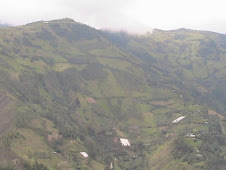
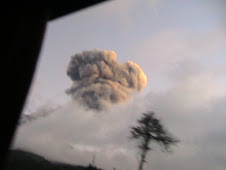
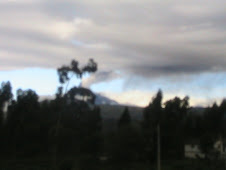
We had several days off from work and school and took the opportunity to go to a place in the north central part of the country called Banos.  It is called that not because it is a toilet, but because there are thermal hot springs there that are generated from the nearby volcano Tungurahua.  This is an active volcano that we saw spewing lots of smoke on our way in, but there was no actual ash falling on the town while we were there.  In 1999 the town of Banos was evacuated for 3 months because some scientific geniuses believed that it was about to erupt.  However, it didn't erupt and the displaced citizens of Banos eventually forced their way back into the town so that they could continue their livelihood as a tourist destination.  
We arrived after a 7 hour journey from Cuenca on buses that showed the worst R17-rated DVD's I have had the displeasure of being exposed to.  On our return trip I asked the conductor not to show such violent and sex filled videos, yet he ignored me and I squelched an urge to fight a one woman mutiny on the bus.  I had a vision of my family standing on the side of the road in the middle of nowhere without our bags but Lizzie's copy of her Beverly Hills Chihuahua DVD in hand.  
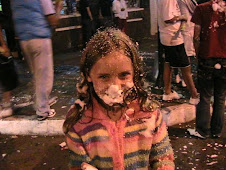
     Once we arrived in Banos we stayed in a decent hostel called "Plantas Y Blanco".  The only problem was that our room was located near the staff cleaning area and they too started Carneval a little early and were constantly having water fights.  Water is not really the substance of choice to play carneval with in Banos.  They prefer espuma or colored shaving foam.  We had the audacity to walk down the main street after dinner one night during carneval and almost made it down the street clean before we were attacked with the espuma.  After the initial shock, we all just started laughing and bought our own cans of the stuff.  The revenge was sweet and it was a lot of fun after all.
     The highlight of our trip to Banos was our whitewater rafting trip.  We took a mini bus to a place on the Pastaza river which had excellent class III rapids. On our way the bus stopped at a bridge where operators were chucking people off the bridge harnessed to a rope.  They would then dangle and swing above the river.  It was almost like bungee jumping without the 'boing'.  Lizzie wanted to do it as soon as she saw it. Given my slight fear of heights I had some trepidation, so I sent the older boy first.  I practically wet my pants watching them jump off a bridge.  Fortunately, I had to concentrate on keeping the video camera steady, so I had something to divert my emotion.  The kids had a blast and both said it was one of the most exciting experiences of their lives.  We continued on to the rafting and had a wonderful day on the water.  Lizzie got the thrill of 'Riding the Bull' which was a particular rapid where she was able to sit at the front of the raft with her legs straddled across the point.  She bounced up and down a bit but stayed on.  Julian was the only one to fall out of the boat.  I think he just wanted a swim at that point.
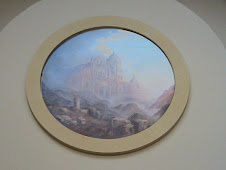
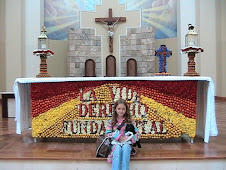
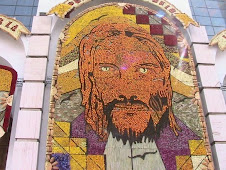
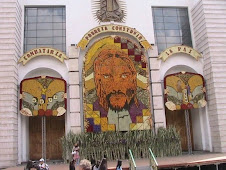
     We were unable to get tickets on the bus from Ambato to Cuenca in the early morning so we had to wait until the next bus a few hours later.  This afforded us the opportunity to look around Ambato. I had met an artist named David Moscoso at a party during my first trip here last year.  He told me he had just finished painting murals at the new cathedral in Ambato. So we took a trip to see his art.  The cathedral was damaged by an earthquake in 1949 and they have been restoring it ever since.  I kind of like a lot of his art, but Norm says it reminds him of 1970's van art.  OK, I might have been a fan of that too.  Remember my blacklight posters? 
     All in all it was a great trip.  Good hikes, good food, carneval excitement, etc.  Then it was back to work to end the cycle.  Norm and I estamos jubilado (we are retired) now.  We will not have formal work until we return to the States.  CEDEI didn't really need us for the upcoming cycle, so we are taking the opportunity to continue to focus on Spanish acquisition and volunteer work while we wind our way back down to our trip home.  

Wednesday, February 25, 2009

Ingapirca

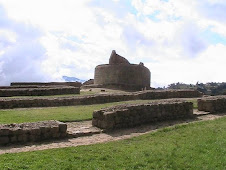
Up the road a piece from here (well up the road, over some mountains, around a roadblock, through some mud, around a town that was having a road race through the middle of it, back out over a mountain - did I mention that driving around Ecuador can pose some obstacles?) lies the best kept Incan ruins in Ecuador, called Ingapirca.  With our trusty guides and friends, Marielena and Henry, two gringo families set off for a weekend adventure and some camping.  We saw an interesting slice of life in "el campo" and more than just a pile of old rocks at Ingapirca.  
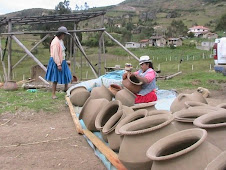
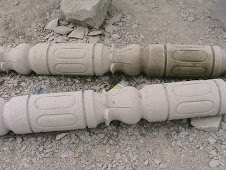
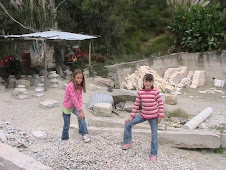
Marielena and Henry were our tour guides on this weekend camping adventure.  Our family was joined by Jeannine, Emily and Felix (sans Dad, Eric). The first day February 7 was a beautiful Saturday and we stopped near the capital of the Canar province, Azogues, less than an hour from Cuenca.  We stopped at a stone cutter's workshop to learn about how they cut stone for columns, animal sculptures, and fountains.  We then moved on to San Miguel to learn about the making of traditional ceramic pots.  This turned out to take up much of the day because the artisans had puppies and the children wanted to spend lots of time with them.  We had lunch, a nice hike, and a somewhat accidental first taste of Zhumir (sugar liquor) for Julian.  He claims to hate the stuff.  
Late in the afternoon we moved on to a beautiful lake to set up camp.  It cooled down at night and there wasn't much firewood to be had, so we worked the fire with the charcoal that was brought on the trip.  The view was beautiful and the night was clear enough to see the full moon.  It was so bright that you didn't need a flashlight for those middle of the night trips to the bushes.  The police decided to check on us a few times, first to make sure we weren't thugs of some sort, and then to make sure we were safe.  Again, safety did not seem like a factor until somebody brought it up.
The next day we had too leisurely of a breakfast and a some short walks.  This made our trip to Ingapirca, the Incan ruins, take longer than it should have.  Apparently, a road race can shut down whole towns and paths through it for many hours.  We finally made it too the ruins and were treated to a lovely lunch.  The tour of the ruins was very interesting, especially when the whole thing was translated into English by our wordsmith son for the German couple who joined our tour.  According to our tour guide, the Incans and Canari lived side by side peacefully for many years until the Spanish Conquest.  It has inspired me to find a good book on the subject.
Next post, Carnaval in Banos!

Wednesday, February 4, 2009

Weekend in Guayaquil

Guayaquil:
January 23 – January 25, 2009


Recent Headlines / News Blurbs from Ecuador:

CONAIE (Indigenous Political Movement in Ecuador) wants to have President Rafael Correa declared “persona non grata” by the World Socialist Forum meeting recently in Brazil.

Ecuador considers joining the regional group ALBA (Alternativa Bolivariana para las Americas) a group consisting of Cuba, Bolivia, Nicaragua, Dominican Republic, Honduras, and Venezuela in contrast to the other regional group ALCA (Area de Libre Comercio de las Americas) an initiative of the USA

Intelligent Email will now be able to intuit mailing destinations even without a formal address.

Daniel Radcliffe of Harry Potter fame declares that the British Royal Family symbolizes all that is bad in Great Britain

La Copa Libertador (South American Club Championships) begins. Deportiva Cuenca qualifies as the equivalent of a “Wild Card” and so must win a home-away series to get into the formal championship. In the first game (away) against Anzoategui (Venezuela) they lose 2-0. In order to qualify they need to win by three goals at home. Result? A 3-0 victory. Favorites to win the Cup (celebrating its 50th Anniversary): Pachuca (Mexico), Boca Juniors (Argentina), Liga de Quito (Ecuador), Sao Paulo (Brazil)

In the wake of Super Bowl XLIII Norm Roessler brings a lawsuit against the NFL in which he claims: 1a) cruel and unusual punishment of having to suffer through the decidedly non-super games of the 1970s and 1b) cruel and unusual punishment of having to hear how every game since the abyss of the 70s is the “greatest game ever." 2) Erasing history by acting as if the NFL did not really exist before 1966; 3) Forcing a hero or MVP upon us, and hence claiming that the individual makes a difference in the world, when football is the living symbol of an arbitrary universe; 4) being a better propaganda unit than Goebbels & Co. (There’s the real crime).


We recently took a trip to the big city – Guayaquil (http://en.wikipedia.org/wiki/Guayaquil) about 3.5 hours by bus and located near the Pacific Coast. We took a van service to Guayaquil this time instead of the usual passenger bus. It cost a few bucks extra, but everyone seemed to prefer the comfort as well as the reduced motion sickness issues upon navigation through the Cajas Mountains. We arrived in Guayaquil on Friday evening and were met by our friends – the Kreis Family. We immediately went to a Steakhouse owned by a famous soccer goalie from Uruguay and were treated to a heapin’ helpin’ of meat – steak, chicken, sausage – and some tasty tripe (well, I liked it). During our stay we came to find the cuisine in Guayaquil to be quite good. Along with the meat, we had a lot of good seafood – ceviche pulpo (octopus) is quite a nice dish. We are starting to think that Cuenca might be a kind of black hole for cuisine in Ecuador as we have not had many great eating experiences there.

After settling in at our friends’ spacious residence outside the city, we spent Saturday walking the Malecón and Las Peñas. The Malecón (breakwater) is the name given to the riverside promenade or boardwalk, which includes lots of gardens and recreational activities. After years of waiting for Philadelphia to develop its riverfront, it was quite refreshing to actually see an urban success.


Las Peñas is at the end of the Malecón and is a renovated neighborhood that one scales with a 444 step walk. Lots of history with terrorists, or I mean pirates (love the whitewash of Western political imagination. (God Bless Captain Jack, Michael Corleone, and Robin Hood) and quite an interesting vista of the city. We finished up our afternoon at Parque Bolivar, also known as Parque Iguana. Yep, that’s right hundreds of iguanas just roaming around, grubbing for handouts, climbing trees, and trying to crap on the heads of humans. What a life!


In the evening we took a ride on a tall ship on the river and got some good views of Las Peñas at night.

On the following day, Julian and Norm threw the baseball around (equipment courtesy of our guest) and then we spent a leisurely, if not decadent, day at the Guayaquil Country Club seeing how the other half in Ecuador lives. All in all a good time in a town that doesn’t always have the best reputation.

We returned to Cuenca on the night van and were somehow survived a near death experience through the Cajas Mountains. With visibility sometimes as little as 2 feet, our driver barely slowed down through the whole mountain trek. When we got to Cuenca we discovered that a massive rain storm had passed through. The End.


Wednesday, January 7, 2009

Holidays Travels and Travails

NOTE: ALL PHOTOS CAN BE ENLARGED WITH A CLICK.


WE wrapped up school and work in Cuenca on December 17 2008 and were on the morning bus to Vilcabamba the next day to start our holidays. Vilcabamba means “sacred valley” in the indigenous Quichua language, and is in the southern part of the country, about 6 hours from Cuenca by bus, and about 100 miles or so from the Peruvian border. If you are checking on the map, Vilcabamba is about 1 hour from the closest major city, Loja. Just a note, Ecuador’s Vilcabamba is not to be confused with the famous and last Incan city of the same name in Peru. For more on this topic consult


I meant to check out the connection but “forgot” to do so while in Vilcabamba. And anyway, Vilcabamba advertises itself as place where one forgets time, history, and all that other burdensome stuff. Supposedly, people live longer there because of the better air and perhaps the hallucinogenic cactus juice. It proved to be quite the relaxing place, even though the trip started off a bit on the downside as Bridget had her purse stolen, and since the camera was in the purse, there is not a photographic record of our visit. Again, seems to keeping in line with the town’s motto.

In Vilcabamba we stayed at a lodge, Izcayluma, nestled in one of the mountains surrounding the town, which provided some wonderful vistas. Run by a pair of German brothers, the lodge offered some good cuisine and a variety of hikes, horseback rides, and massage appointments.

We did a bit of hiking, with Jules and Norm able to do the Mandango Trail – a four-hour jaunt that allows one to walk on top of the ridgeline over a number of peaks. On the ridgeline, one could get a 360° view of the Andean Mountains leading from Ecuador into Peru. Quite impressive, and probably one of the top hiking moments one can experience. No personal photos, but here is a link with some images:


After our stay in Vilcabamba, we bussed back to Cuenca for Christmas. It was a quiet affair with only a small tree and our new Iguana model (Iggy) to keep us company. Just the right tonic from the normal Xmas pressure found in the U.S. On Christmas Eve we watched, El Pase del Niño, a long procession of cars, people in costume, and of course, lots of kids, pass through the town. An old tradition, which seems to be particularly big in Cuenca. As the pictures show, lots of religion mixed with food (pig, guinea pig, and chicken), along with pop culture. Sort of like seeing Jesus at the Mummer’s Parade eating a Philly Cheese Steak. On Christmas Day, we spent time relaxing with friends, playing Scrabble in Spanish, and watching the movie Tropic Thunder (“I don’t read the script, the script reads me.”)

We planned on spending a few more days in Cuenca, but our trip to the Amazon, forced us to catch a flight on December 27 to Quito. This turned out to be fortuitous because we had yet to spend time in Quito, and our short stay (1.5 days) proved to be quite interesting. Quito, like Cuenca, is nestled in the mountains, and has pretty much the same climate. The old city was quite nice with narrow streets, excellent architecture, and a great deal of cathedrals. Definitely need to spend a bit more time in Quito in the future!

Next, it was onto the Amazon. Unable to catch a flight from Quito to Lago Agria (the launching point for trips to the northern Amazon basin, or “Oriente”) we were compelled to take a bus. Seeing as it was only about 150 miles, we figured we could handle the 6-7 hour bus ride. 9 hours later with a bag of vomit to show for our exertions we found ourselves in Lago Agria. It definitely lived up to its reputation of being a “rough frontier town.” The “Oriente” up until the late 1960s was a very underpopulated and isolated place. But they struck oil in them there jungles ca. 1968 and so a number of oil towns sprang up, Lago Agria being one of them. For some reason, the financial windfall of the oil industry has not trickled down too much to the town. Certainly, it has provided many people with a livelihood – through the oil industry or the tourism industry – but the town itself is a pretty dismal affair. Literally, it has the feel of a town from the Wild West. So, maybe something interesting to find there, if one wants the frontier experience, but we spent only a night there and then traveled to our camp in the jungle.

Add 5 hours (another bus ride and then a canoe trip) to the initial bus ride, and you finally see us in our camp in the Cuyabeno Reserve. The lodge itself was nice and had a bit of a Gilligan’s Island feel to it with the thatched rooves and hammocks. We came at the end of the dry season, so the river level was down and it did not rain until our last few days in the jungle. Supposedly this made for a bit better viewing of wildlife.


W
e took our first hike an hour or two after arrival. It was a night hike through the jungle and allowed us to see a number of spiders and frogs along with a stray scorpion. In the following days we got down to business and took numerous canoe trips and hikes in the reserve.
We fished for piranha, searched for caiman at night, visited a shaman, and went hunting for anaconda. The anaconda hunt was fascinating. We had to walk through the dry riverbed, navigating deep mud, until we finally found the anaconda track and its lair underneath a tree trunk. We got a few peaks of the monster, but ultimately could not get it to come out, despite the guides repeatedly sticking the ground with various objects (I know it sounds like a Fox Video Special, “When Animals Attack,” but it didn’t seem that stupid at the time). Despite not seeing the beast, I will always remember the ground moving as it eluded the prodding of the guide’s sticks.


A last note on our Amazon trip – we celebrated New Year’s in the jungle. Again, nice to get a different version of the celebration. We sat around a bonfire drinking beer and cuba libres and danced to reggaeton. Lizzie and Julian even got out on the dance floor, with Julian continuing his "tween" Bildungsroman, and actually asking a local girl to dance. As the clock struck midnight, two life-sized puppets (actually effigies of the owners of the camp) were tossed on the bonfire, and people started leaping over the fire. No photos of this event, but we did shoot some video and a later blog we’ll hopefully be posted with video segments.

So, now we are back to Cuenca and our daily routines again: the kids are back at school, and the parents are working at the language institute. Tough times seem to be hitting the language institute – a dearth of students. No extra money coming from all the Ecuadorians who work abroad seems to have made English a luxury and not a necessity. Go figure.

But life goes on. We note that, as of the writing of this blog, the Eagles have advanced to the playoffs and even won a game. Of course, this is more evidence that our going abroad has led to Philadelphia sports success. We like Malaysia, so why don’t you all start sending money to keep us abroad and insure that Philadelphia continues its new winning tradition in sports.

If you don’t choose to support this effort, then we will just have to come home and introduce the new adjectival WMD “unitedstatesian” into the American vocabulary. Of course, I assume that most Americans will embrace this linguistic “great awakening” like they embraced the last 29 years of the most recent “great awakening.” Just think, no more “Uh-mer-i-kan” as in, “I’m an Uh-mer-i-kan,” but rather, “I’m an Unitedstatesian.”

Friday, December 26, 2008

Partaaaaaay!


I don't think it's just us, but the people we associate with here love to party.  Since Halloween, we have not gone a week without at least one social gathering, and in many cases there are 2 or 3.  Even the students who we volunteer to teach English to in the Artisan Market had a little party with small gifts for the teachers.  There were birthday parties, Halloween parties, Christmas parties, and just hanging out with friends.  Check out our social life in these pictures.  I wish I could figure out how to label them all, there are limits to my technological prowess.

CEDFI XMas Parade


What will everyone remember or forget from this trip?  It's hard to say exactly, but as one of our English friends, Robert, said, I don't think Julian will forget being the volcano in Ecuador.  CEDFI organizes a really great parade that all the kids in the school participate in.  Each class chooses a special theme and then they create a float for the parade that travels through the center of the city.  Julian's class chose to do a theme of the old time Ironworkers (Los Herreros).  However in addition to the carts of Herreros banging away on steel, they had a huge volcano on their float. Julian was selected by his class to be emerging from the top of the volcano.  Eliza's class chose the theme of traditional campesinos called Cuyembenos.  She was dressed in a colorful costume and made a great gringo Cuyembena.  The parade took place on Saturday December 13.  It was an amazing cultural experience and a great prelude to the larger event that occurred on Christmas Eve called Pasa del Ninos.  This is an all day parade of children in costumes on floats to celebrate Christmas.
We miss everyone, especially around the holidays, but we have been enjoying our break.   

Wednesday, November 26, 2008

Zip lining


One of the things I like the best about living in another country is that you get to do dangerous things that you can't do at home.  I don't think there are places in the legalistic dominion of the USA where they have zip lining, because the insurance probably would be prohibitive.  Although I still can't figure out how ski resorts survive.  So on a beautiful Sunday in November, Julian, Lizzie and I went with our new family friends from Colorado Janine, Emily (7), and Felix(4) to Cuenca Canopy.  The men had some other bold adventures to take care of that day. So we all suited up to be flung out on cables across gorgeous 350 ft. ravines.  Felix did the first two lines only because of his age, but he was so nonchalant about he event, I am sure he could have done all 6 lines.  After getting over my fear of heights, I allowed myself to look down during the sail.  Then all of us started trying the different styles that you can do with the guides.  Of course, Julian was the first to try the Superman style.  This is where the guide holds onto your legs from behind and you fly with hands outstretched Superman style to the other side. All of the kids tried this. Then there is the Mariposa (butterfly) where you face the guide and straddle his legs.  He holds on to you and when you start sailing across, you let go of the cable and hang upside down in an X. This is pretty outrageous and I screamed my whole way across, but it was fun. Don't get the idea from Julian's lack of smiles(he is preteen and pictures aren't as cool) that he didn't enjoy himself. He did, as did we all.